
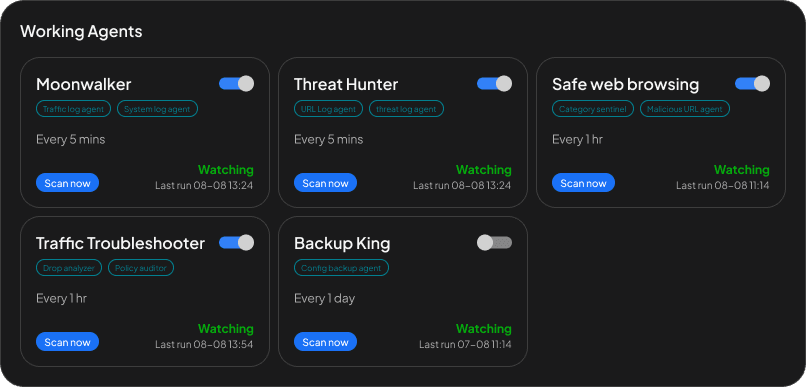
What is AI firewall management?
Traditional firewall administration often requires engineers to move between vendor consoles, search large log sets, compare configuration states and manually document findings. An AI operations layer can combine this context and let an operator ask questions in natural language, such as “Which policies changed today?” or “What caused the traffic spike from this source?”
AI does not make a firewall protective by itself. The firewall still enforces network policy. The AI layer helps people understand current conditions, prioritise work and execute approved workflows more consistently.
How does AI work with enterprise firewalls?
- Collect context.Connect to permitted device APIs, inventory, telemetry, logs, tickets and change records.
- Interpret intent.Translate a natural-language request into a defined diagnostic, reporting or operational workflow.
- Use specialised tools.Call narrow tools for health checks, traffic analysis, policy review, backup, reporting or ticket updates.
- Present evidence.Return the sources, affected assets, reasoning trail and recommended next action.
- Control changes.Keep configuration writes behind scoped permissions, validation and explicit approval.
- Verify the outcome.Check post-change health and preserve the result in the incident or audit record.
Where can AI improve firewall cybersecurity?
Real-time monitoring
Summarise traffic behaviour, device health and significant events across connected firewalls.
Threat investigation
Correlate logs, source information, policy context and recent changes to accelerate triage.
Configuration audit
Identify changed, unused or potentially risky rules for an engineer to review.
Troubleshooting
Run repeatable diagnostics and bring likely causes, affected paths and evidence into one view.
Reporting
Turn current operational context into structured executive, technical and compliance reports.
Incident workflow
Create and update evidence-rich tickets while preserving ownership, priority and status.
See these workflows in the CloudX AIOps product screens and the closed-loop incident workflow.
What controls should an AI firewall agent have?
A production AI agent should not receive unrestricted administrative access. Security teams should define separate permission boundaries for observation, analysis, recommendation and execution.
| Operation | Recommended default | Control |
|---|---|---|
| Read inventory and health | Automated | Read-only connector scope |
| Analyse logs and policies | Automated | Logged tool calls and evidence |
| Recommend configuration | Automated draft | Validation and impact preview |
| Change firewall policy | Human-approved | RBAC/ABAC, approval and rollback |
| Close incident | Verified workflow | Post-action checks and audit trail |
This model aligns with the principle that authentication and authorisation should be discrete, policy-driven decisions. NIST’s Zero Trust Architecture guidance focuses on protecting resources and avoiding implicit trust based only on network location.
How should you evaluate an AI firewall management platform?
- Deployment and data boundary: Know where the model runs and whether operational data leaves your environment.
- Connector depth: Validate supported vendors, versions, APIs, telemetry and required privileges.
- Evidence and explainability: Require source context, tool history and reproducible findings.
- Change control: Confirm approvals, scoped roles, validation, rollback and separation of duties.
- Operational fit: Test the platform against real investigation, audit and reporting workflows.
- Measurement: Track accuracy, time to investigate, false positives, approval outcomes and exceptions.
The NIST AI Risk Management Framework describes AI risk management as a continuous practice spanning governance, mapping, measurement and management. Those ideas are directly useful when assessing an AI system that participates in cybersecurity operations.
Authoritative references and further reading
- NIST AI Risk Management FrameworkTrustworthy AI risk governance and lifecycle guidance.
- NIST SP 800-207: Zero Trust ArchitectureResource-focused access, authentication and authorisation principles.
- NIST Cybersecurity Framework 2.0Risk management outcomes for cybersecurity programmes.
This guide is maintained by CloudX Solutions, the team building and operating CloudX AIOps. Product statements describe the platform shown on this website; framework statements link to their primary sources.